Preparing Your K2 Child for Primary 1: The English Readiness Skills Parents Often Overlook
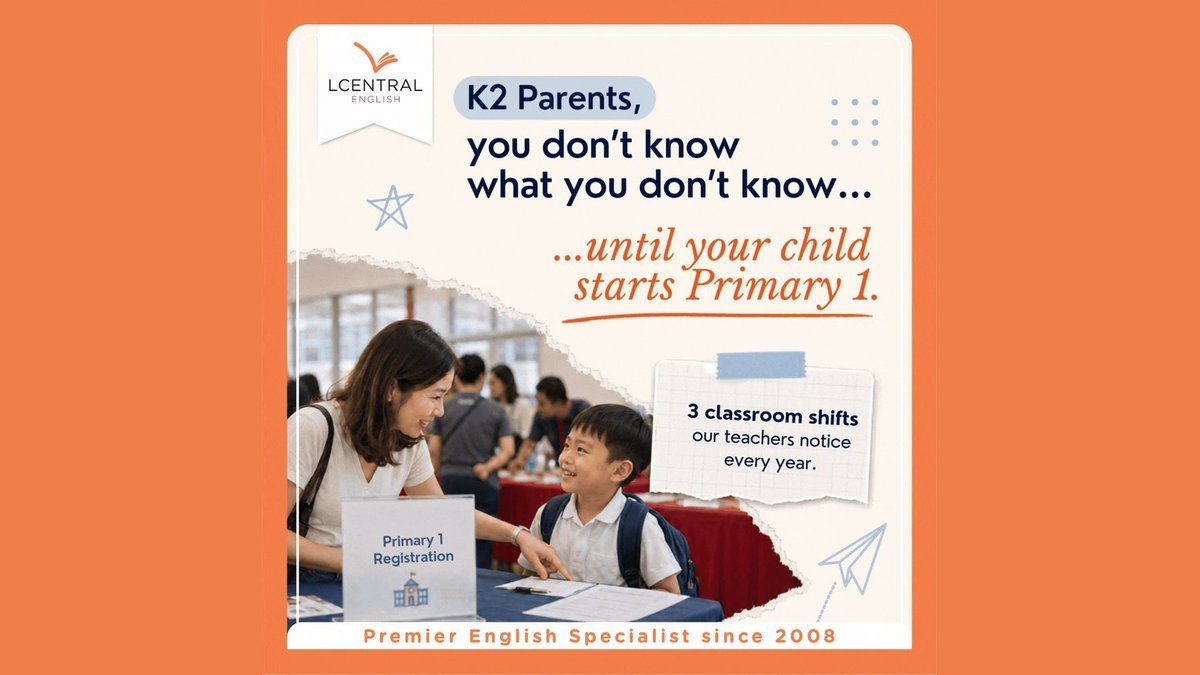
Quick answer: A child is ready for Primary 1 English not when they can read the most words, but when they can understand what they read, follow instructions independently, and keep going when the work gets harder. Reading fluently is only the starting line. The skills that decide how well your child settles into Primary 1 are comprehension, listening, focus and confidence, and these can all be nurtured gently in the months before school begins.
If your child is in Kindergarten 2 this year, this is a big season for your family. Right now, across Singapore, parents are going through the 2026 Primary 1 Registration Exercise, securing a place for the January 2027 intake. It is exciting. It is also the moment many parents quietly start to wonder: is my child actually ready?
Most parents are doing everything right. But unless you have already been through the Primary 1 journey, there are important parts of school readiness that are simply not obvious. You do not know what you do not know, and that is completely normal.
This guide walks you through what changes in Primary 1, why English is often the hidden challenge, the three shifts our teachers notice in classrooms every single year, and the simple things you can start doing at home today.
Kindergarten and Primary 1 are not the same journey
In kindergarten, teachers give a high level of guidance. They remind children what to do, help them organise their things, and repeat instructions several times.
Primary 1 works differently. A teacher may give an instruction once, to a class of 30 children, and expect everyone to follow it independently. In a typical week, your child may need to:
Copy homework from the board
Pack the correct books for the next day
Finish a task within a time limit
Follow instructions with several steps
Manage recess on their own
Ask for help when they are stuck
This is why a child who is academically strong but very dependent on adults can struggle more than a child with average academic skills and strong independence. Readiness is not only about what your child knows. It is about how independently they can use what they know.
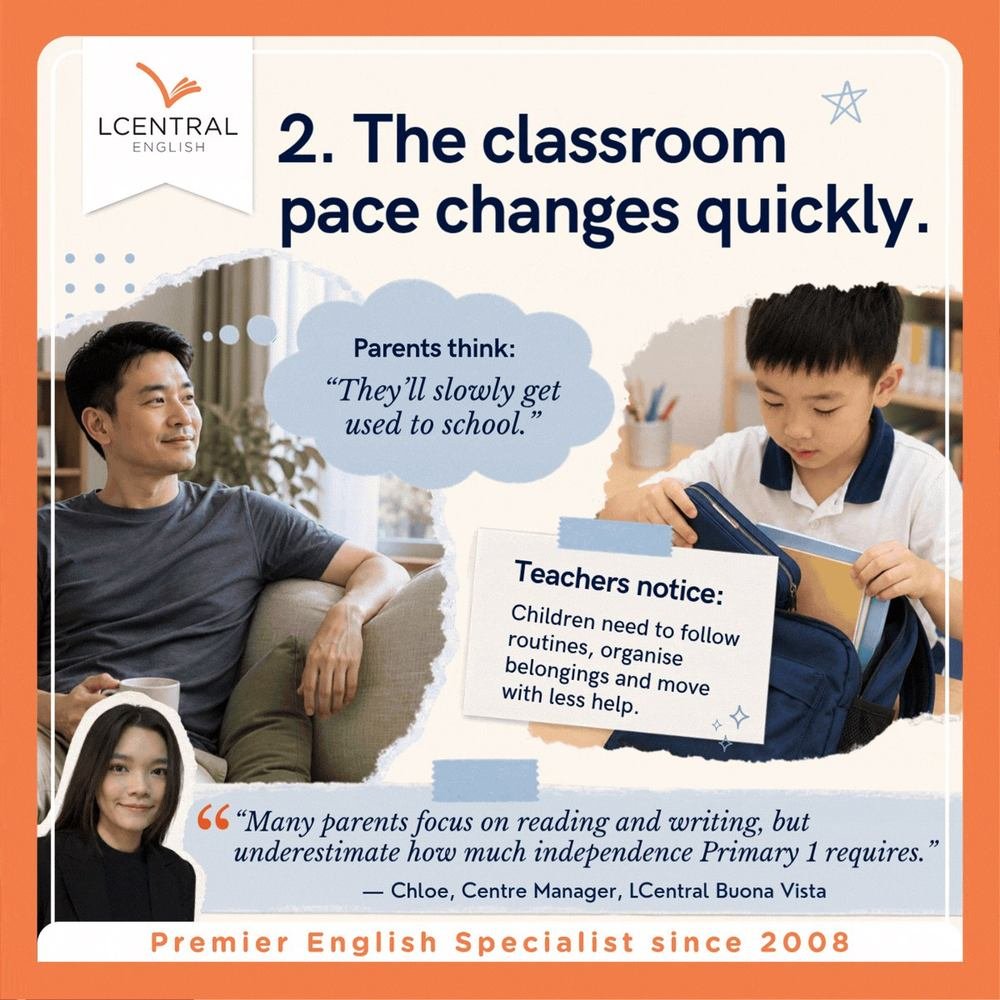
"Many parents focus on reading and writing, but underestimate how much independence Primary 1 requires." Chloe, Centre Manager, LCentral Buona Vista
English is often the hidden challenge
Many parents are surprised when their child struggles with English in Primary 1, because at home the child seems to be doing well. They read storybooks aloud, recognise plenty of words, and speak English confidently.
Yet reading the words is not the same as understanding them. Primary 1 English, taught through the MOE STELLAR programme (Strategies for English Language Learning and Reading), asks children to do more than decode text. They are expected to retell a story in their own words, predict what happens next, understand why a character behaved a certain way, and pick out the main idea from the details.
That calls for a deeper set of skills:
Vocabulary wide enough to make sense of new passages
Inference, reading between the lines rather than only the literal words
Sentence understanding, following how ideas connect
Listening and processing, absorbing instructions the first time
If your child is still building the very first layer of these skills, our guide to developing pre-reading skills is a good place to start.
And here is the part parents rarely realise. English is not just one subject. It is the foundation under all the others. A Primary 1 maths question is no longer "3 + 4". It is a short story: "Siti has 3 apples. Her friend gives her 4 more. How many does she have now?" A child who cannot comfortably read and understand that sentence will lose marks in maths, not because of the numbers, but because of the reading.
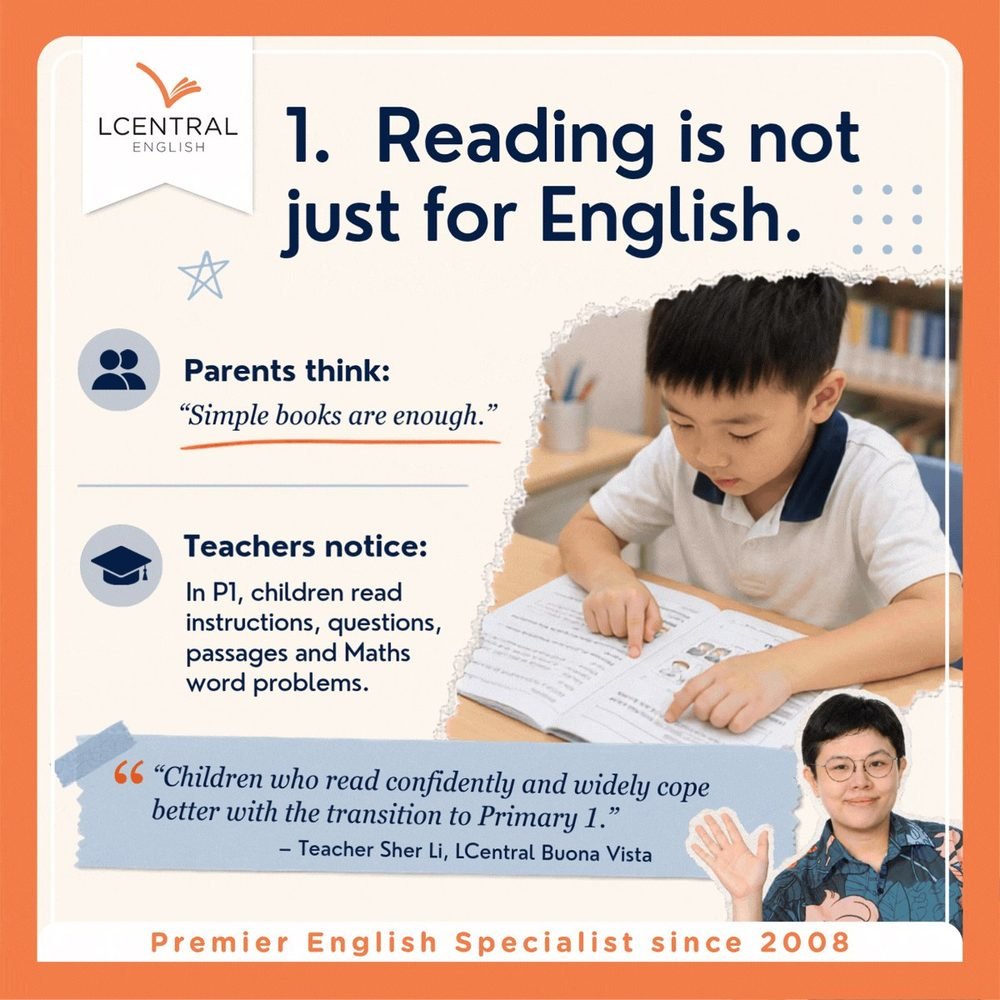
"Children who read confidently and widely cope better with the transition to Primary 1." Teacher Sher Li, LCentral Buona Vista
The three shifts our teachers notice every year
Every year, our teachers watch new Primary 1 children settle in. Three patterns come up again and again, and they are worth knowing before the first day.
1. Reading is not just for English
Parents often think, "simple books are enough." In Primary 1, children read instructions, questions, passages and even maths word problems all day long. Strong, confident readers cope with the whole school day better, not just the English lesson.
2. The classroom pace changes quickly
Parents often think, "they will slowly get used to school." In reality, the pace picks up fast. Children need to follow routines, organise their belongings, and move on with less help than they had in kindergarten. Independence becomes a daily skill.
3. Finished does not always mean understood
Parents often think, "if my child finishes the worksheet, it is fine." But finishing is not the same as understanding. A child who copies steps without really following them can hit a wall later, when questions are worded differently and there is no example to copy.
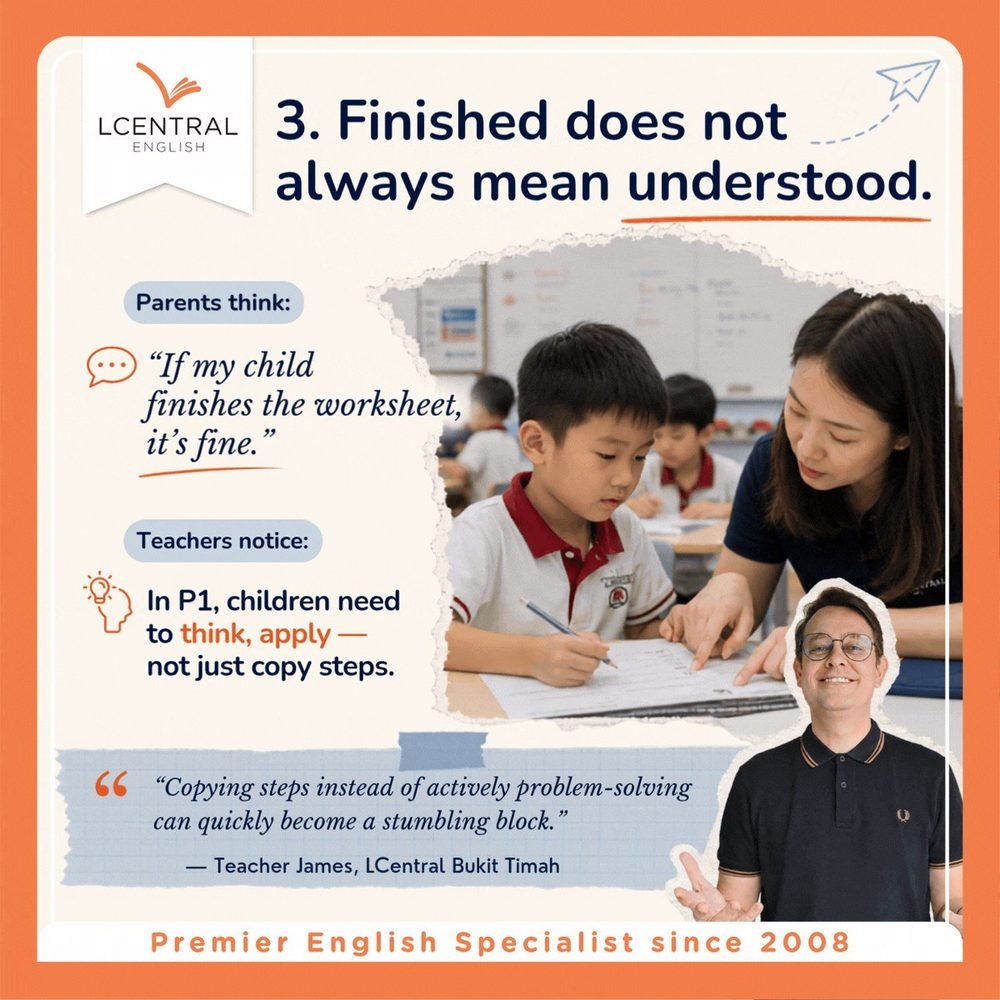
"Copying steps instead of actively problem-solving can quickly become a stumbling block." Teacher James, LCentral Bukit Timah
Already been through Primary 1 once? This time can be different
If this is your second child, you have an advantage. You have done the P1 registration, the uniforms, the first-day nerves. But a word of gentle caution from our teachers: what worked for one child may not work for another.

"Children walk into a Primary 1 classroom from very different starting points." Teacher Michael, LCentral Woodlands
The most common trap for second-time parents is comparing too quickly. An older sibling who took to reading early does not tell you what the younger child needs now. Comparison can create pressure where encouragement would work better.
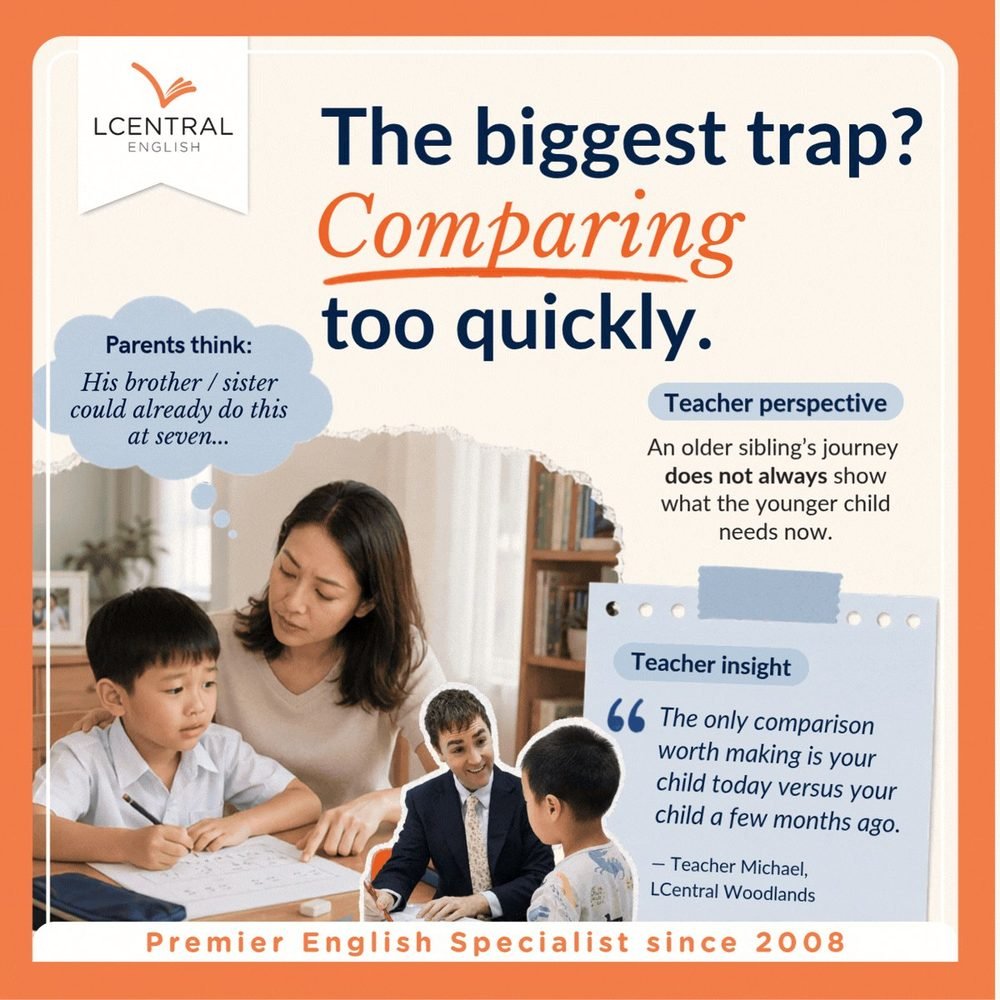
"The only comparison worth making is your child today versus your child a few months ago." Teacher Michael, LCentral Woodlands
Every child deserves their own Primary 1 journey. The goal is not to repeat what you did before. It is to look closely at this child, and meet them where they are.
Five signs your child is building real English readiness
Rather than asking "can my child do Primary 1 work?", ask "is my child ready for the Primary 1 journey?" These five signs matter more than knowing the right answers:
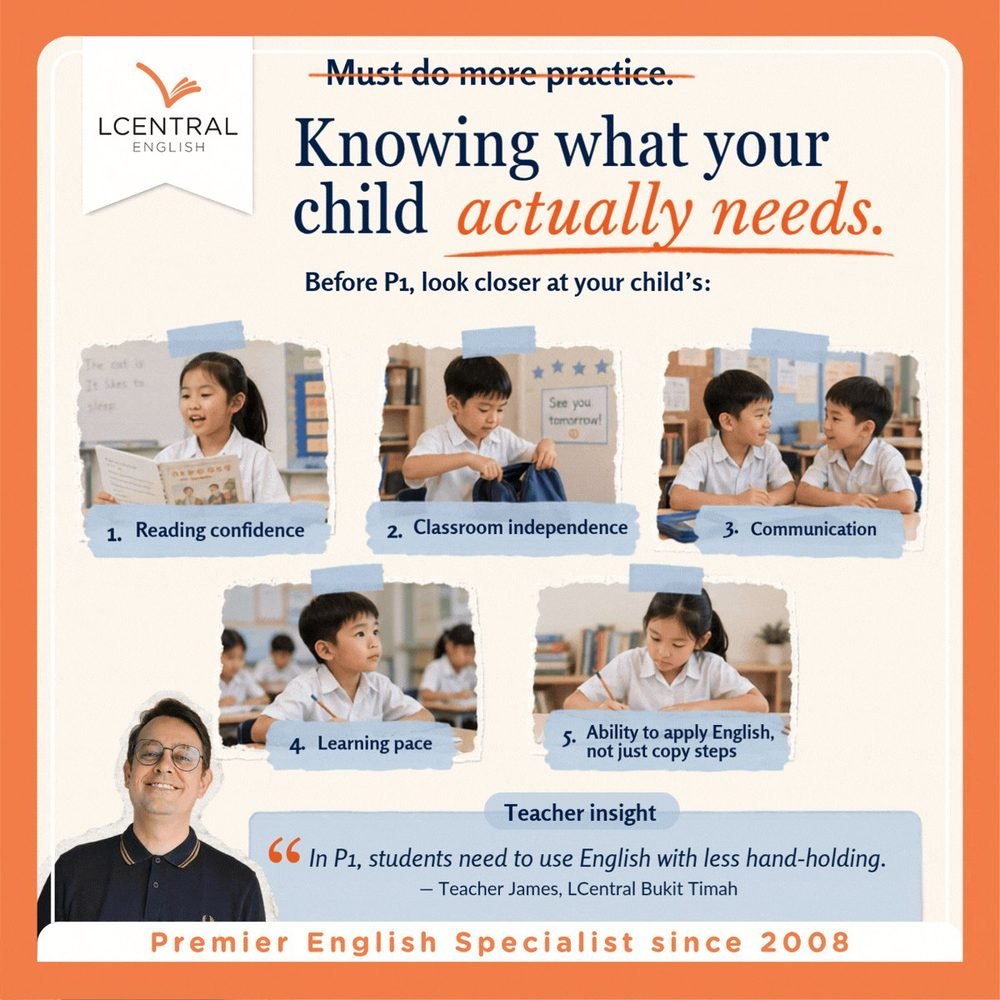
Reading confidence. Your child enjoys books and is willing to try unfamiliar words, rather than freezing or giving up.
Listening and following instructions. They can hold a two- or three-step instruction in their head and act on it without constant reminders.
Sustained attention. They can sit with a task and see it through, even with small distractions around them.
Comprehension, not just reading. They can tell you what a story was about and why something happened, not only read it aloud.
Applying English, not copying steps. They can use what they know in a slightly new situation, rather than only repeating a memorised example.
"In Primary 1, students need to use English with less hand holding." Teacher James, LCentral Bukit Timah
What parents can do now, at home
The good news is that readiness is not about drilling endless worksheets. It is about building strong foundations, and most of it can happen naturally at home.
Build a daily reading habit, then talk about it. Read together every day, and afterwards discuss it: what happened in the story, why a character acted that way, and what might happen next. The conversation matters as much as the reading. If reading is a struggle at home, these ideas for helping your child love reading may help.
Strengthen listening. Give simple instructions with two or three steps and let your child carry them out on their own. It builds the exact skill Primary 1 demands.
Encourage problem solving. Instead of giving the answer straight away, ask, "what do you think?", "how did you work that out?", or "can you try another way?"
Grow independence. Let your child pack their own bag, prepare small things themselves, and follow daily routines with a little less help each week.
Praise effort, not just correct answers. Children who have never faced a setback can become discouraged when work turns difficult. Teaching them that mistakes are normal, effort matters, and asking questions is welcome, builds the resilience that Primary 1 quietly requires.
How LCentral supports the K2 to Primary 1 leap
At LCentral, we have specialised in English for young learners since 2008. Our approach is not to rush children into Primary 1 worksheets early. It is to build the reading confidence, comprehension and independence that make the transition smoother, so your child walks into Primary 1 ready to learn, not just ready to cope.
For children at this stage, that usually means our LiftOff Learn-to-Read programme for building confident, independent readers, and LiftOff Primary Practice for K1 and K2 children getting ready for the pace of primary school.
If you are not sure where your child stands, our friendly staff can offer insights into your child's language and reading ability, and recommend the best programme to boost your child's literacy, confidence and independence.
Because when it comes to Primary 1, the goal is not to teach your child everything before school starts. It is to give them the skills to learn anything.
Related reading: How can I help my preschool child prepare for primary school?
Follow LCentral English on Facebook and Instagram for more Primary 1 readiness tips from our teachers.
Frequently asked questions
How do I know if my child is ready for Primary 1 English?
Look beyond whether they can read the words. A ready child can understand what they read, follow multi-step instructions on their own, stay focused on a task, and keep trying when it gets harder. Reading fluently is the starting point, not the finish line.
My child reads fluently. Is that enough for Primary 1?
Not on its own. Primary 1 English, under the MOE STELLAR programme, expects children to retell, predict, infer and find the main idea, which are comprehension skills. Reading aloud is important, but understanding what is read matters even more.
When is Primary 1 registration in 2026?
The 2026 Primary One Registration Exercise runs in phases from late June to August, for the January 2027 intake. Phase 2C runs from 28 to 30 July 2026, and Phase 2C Supplementary from 17 to 18 August 2026. Check the MOE website for your child's phase.
How early should we start preparing for Primary 1?
The K2 year is the ideal window. There is no need to drill Primary 1 content. Focus instead on daily reading, listening, independence and confidence, which develop gradually over months rather than weeks.
What is the STELLAR programme?
STELLAR (Strategies for English Language Learning and Reading) is the MOE English curriculum used from Primary 1 to Primary 6. It builds literacy through shared reading of Big Books and authentic children's texts, with a strong focus on comprehension and using language, not only decoding words.


Comments